Following a recent story about how recent Low Traffic Neighbourhoods have reduced road Casualties in Cowley East Oxford by at least 30 in three years, we saw a rise in myths and misinformation in response.
We have produced this guide to set out the facts – please contact us on info @ cohsat.org.uk if you spot anything that is incorrect, and we will update it.
Road casualties on main roads
Fact: Casualties on the main boundary roads of the Cowley LTNs have reduced by 25%
As we stated clearly on our analysis blog, BBC Radio Oxford and BBC South Today, and contrary to misinformation from Cllr Sajjad Malik and some other commentators, our analysis includes the main roads near the recent Low Traffic Neighbourhoods. This would be clear with a brief glance at our analysis – casualties on the main roads bounding the Cowley LTNs fell by 25% as part of an overall 36% reduction.
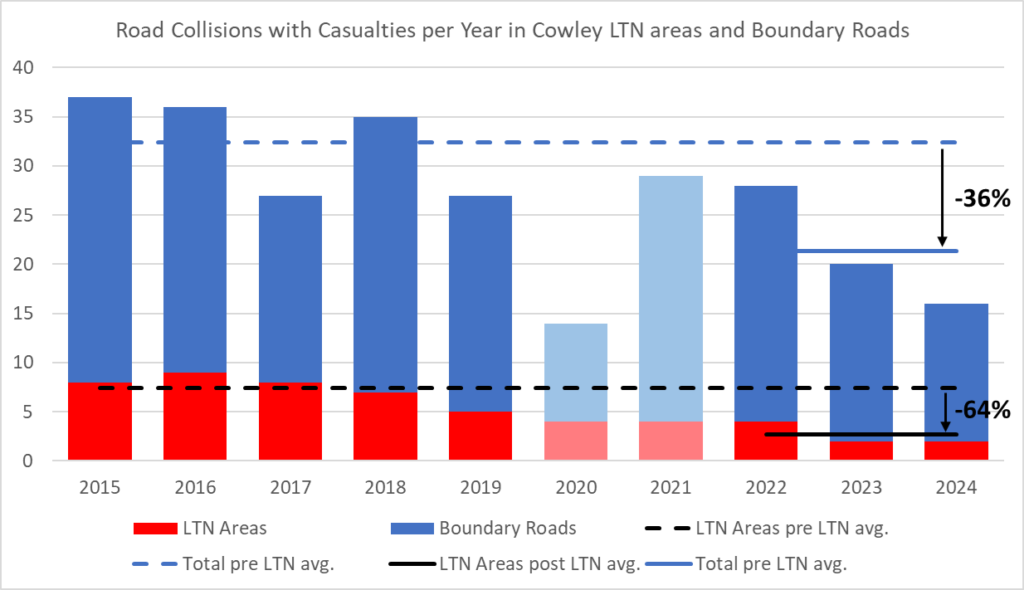
The Boundary roads include Rose Hill/Henley Avenue, Church Cowley Road/Between Towns Road, Barns Road, Oxford Road, Hollow Way, and Newman Road. The difference for boundary roads in aggregate is significant at a 90% confidence level (P=0.067). For individual roads, the casualty changes are mostly too small to be statistically significant, apart from Oxford Road, which has seen a 50% reduction (P=0.034).
Traffic volumes and congestion
Fact: Traffic volumes have not increased on the main roads since before Covid
It is often said that the LTNs have increased congestion on main roads due to ‘traffic displacement’.
The first issue here is ‘false equivalence’. Low Traffic Neighbourhoods reduce injuries from road traffic crashes – some of these can be life-changing. They remove NOx and particulate pollution from residential areas where people, particularly young children with developing brains, would be breathing it 24/7. The major harms of injury and heart, lung and brain disease should not be held equal to traffic congestion.
The second issue is that traffic congestion is caused by the people complaining about it. “You are not stuck in traffic, you are traffic.” – as originally coined by satnav maker TomTom.
Even then, the picture is not clear. Traffic on main roads has only ever risen to the levels that it was before the Covid-19 pandemic, and that rise happened at the time the LTNs were being installed.
The traffic jams were already a long-standing problem on these roads – this 2016 Oxford Mail article mentions Cowley Road, London Road and Iffley Road among Oxford’s ‘Nightmare Roads’. These traffic jams were one of the reasons that drivers were rat-running down residential streets, why Low Traffic Neighbourhoods were developed to protect the residents, and why the Traffic Filters were planned to reduce the congestion problem.
It’s quite possible that people got stuck in the jams returning after Covid, looked for something to blame, and now had the LTNs to point at.
Oxford Road and Cowley Road
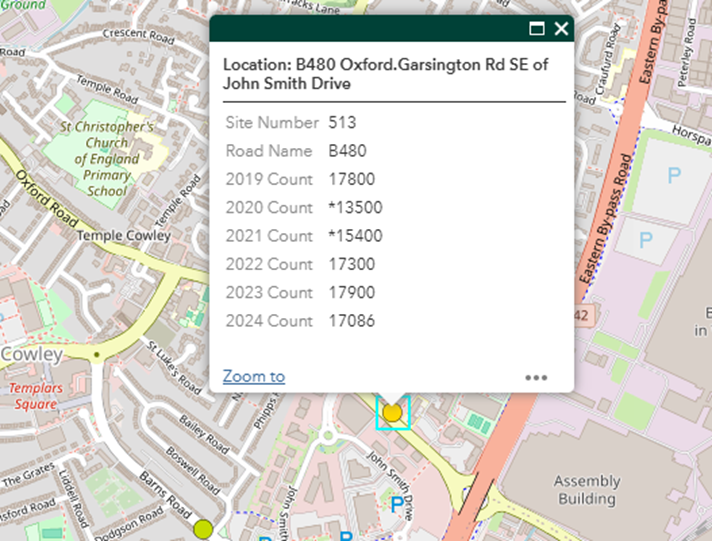
Traffic counter 513 is just inside the Ring Road. Its 2022 to 2024 counts are very similar to the 2019 count. Note how much lower the 2020 and 2021 counts, affected by the pandemic lockdowns, are.
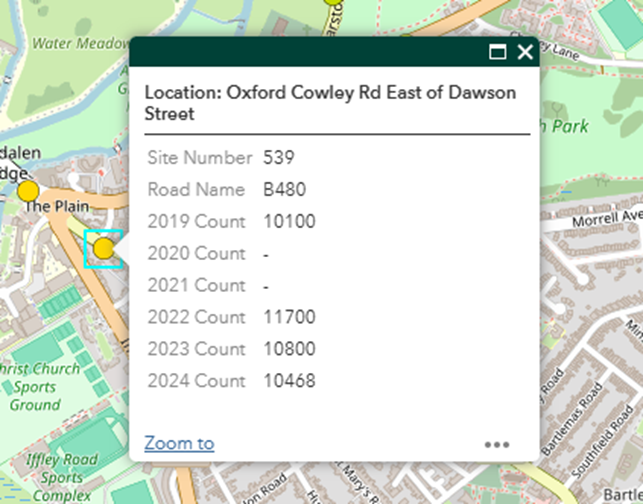
Traffic counter 539 is at the northwest end of Cowley Road. Its 2024 count is 3.6% higher that 2019, representing less than a 1% annual growth rate.
Iffley Road and Rose Hill
Counter 752 near Charles Street has only been active since 2023, so does not have sufficient data to be useful.
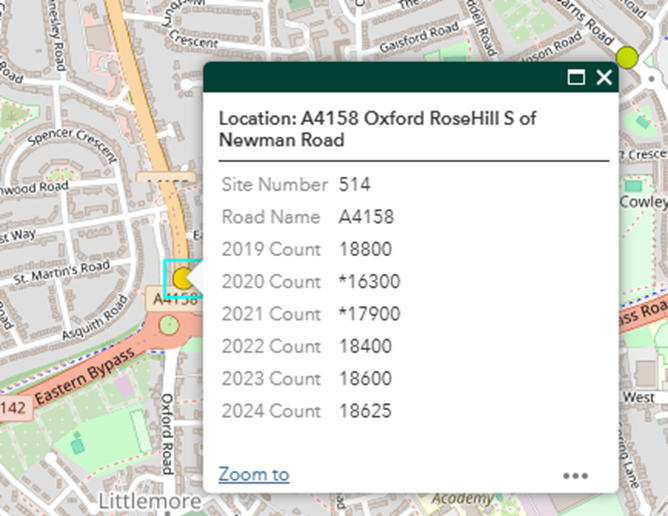
Counter 514 is just inside the Ring Road and the 2022 to 2024 traffic counts are all less than 2019.
London Road and St Clement’s
Traffic counter 510 just inside the Ring Road has no data from 2019, so is not useful for this purpose.
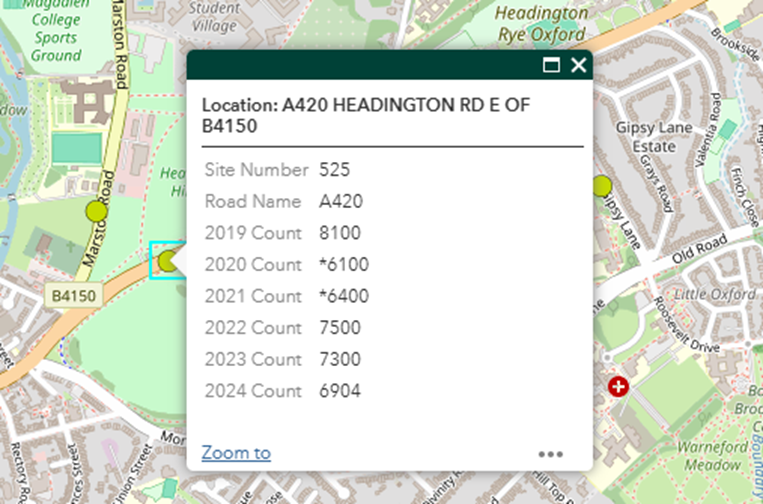
Traffic counter 525 on Headington Hill shows a reduction in traffic since 2019.
Traffic counter 751 on St Clements has only been in operation since 2023, so does not have useful data for this purpose. But it was identified in a Council paper that there were delays to buses westbound on St. Clements in the afternoon and evening peaks, likely due to difficulties entering the roundabout. With the Temporary Congestion Charge from October 2025, these difficulties have been removed.
Pollution
Fact: At every single monitoring point in the city, air pollution is lower than is was before the LTNs
Oxford City Council collects air pollution data. “The latest report shows that, “All the monitoring locations both inside and on the boundary roads of Oxford’s LTNS showed a decrease in NO₂ levels measured in 2024, compared to 2023.”
Air pollution levels in Oxford continue to improve in 2024
Specific myth or misinformation revolved around air pollution on Boundary Roads. Air pollution has been measured at 8 points on recent LTNs since before those LTNs were implements in 2021 (Cowley) and 2022 (East Oxford). In every case, the air pollution has reduced over the implementation of the LTNs and since.
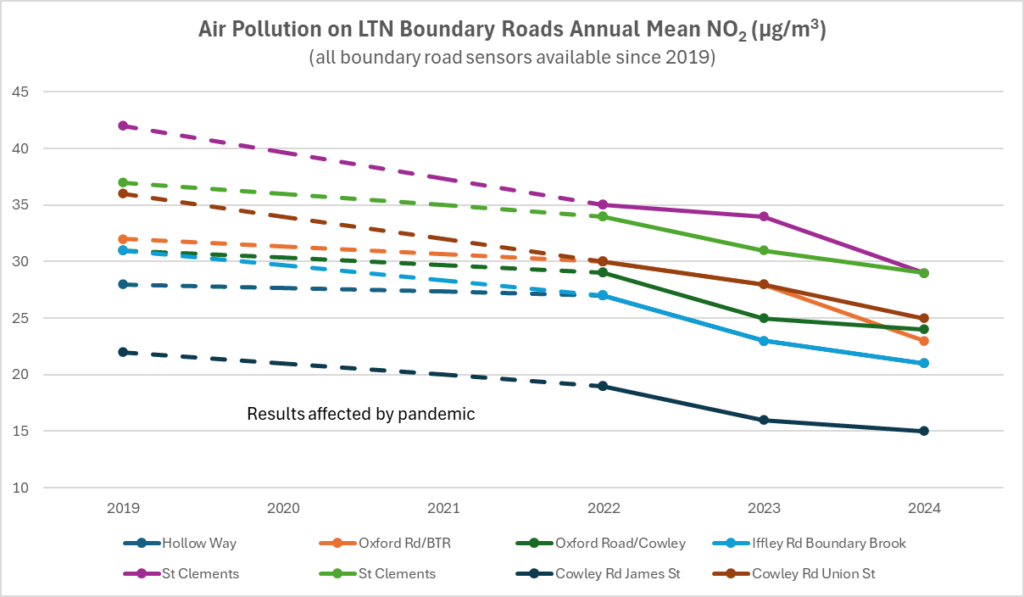
Some of this reduction may be due to improving vehicle emissions.
In the LTNs themselves, people are also benefiting from cleaner air as well as reduced injuries. Residents have reported cases of asthma clearing up.
There is no safe level of air pollution, and we support further measures to reduce air pollution in our towns and cities, through reducing traffic, the pollution it causes, and other interventions such as reducing wood burning.
LTN distribution across the city
Fact: Low Traffic Neighbourhoods are widely spread across Oxford, and have been implemented for decades on the basis of traffic problems, not ‘class’ or other demographic attributes.
Sometimes anti-LTN campaigners say that LTNs are not applied to the richer areas of Oxford, because those area would suffer. Sometimes they say they are only applied to the richer areas of Oxford, leaving other areas to suffer. Neither of these are true.
Interventions the same as Low Traffic Neighbourhoods, but without the name or the abbreviation LTN have been applied across Oxford and other towns and cities to reduce the problems caused by traffic for decades.
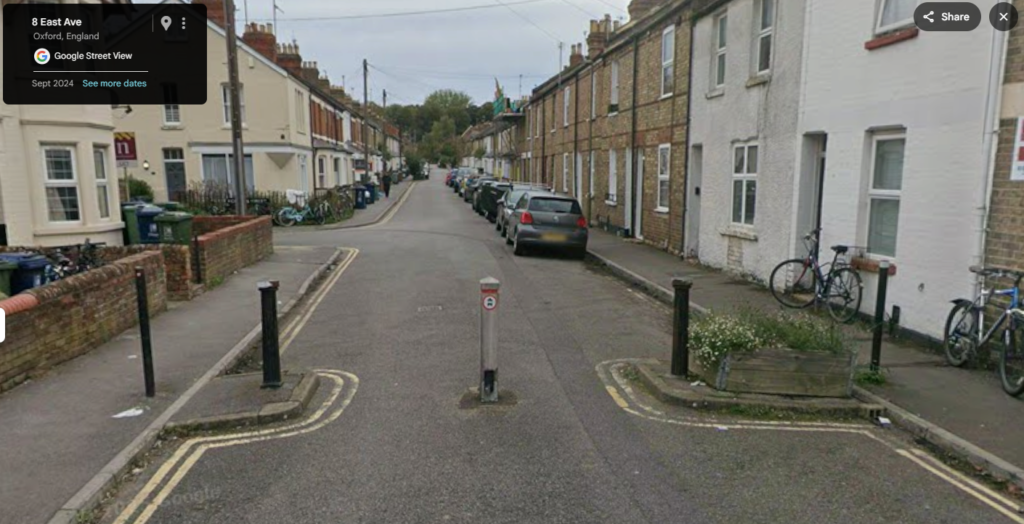
East Avenue, for example, was closed to through traffic in 1985.
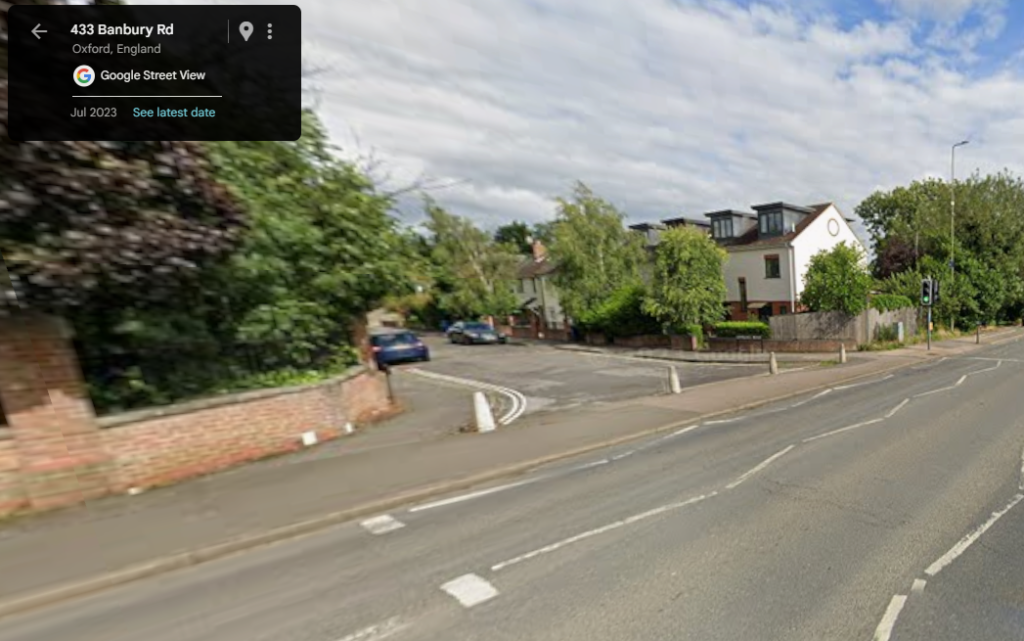
In North Oxford, Cutteslowe is a low traffic neighbourhood with bollards on several streets including Lovelace Road and Holts Weer Close.
Blogger Wandering Danny has catalogued existing LTNs in every part of Oxford.
The recent Cowley LTNs encompass a wide spread of demographics – six of the ten deciles of the Index of Multiple Deprivation, very much representative of Oxford.