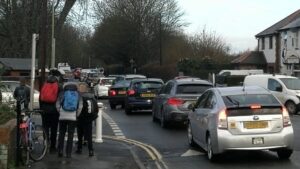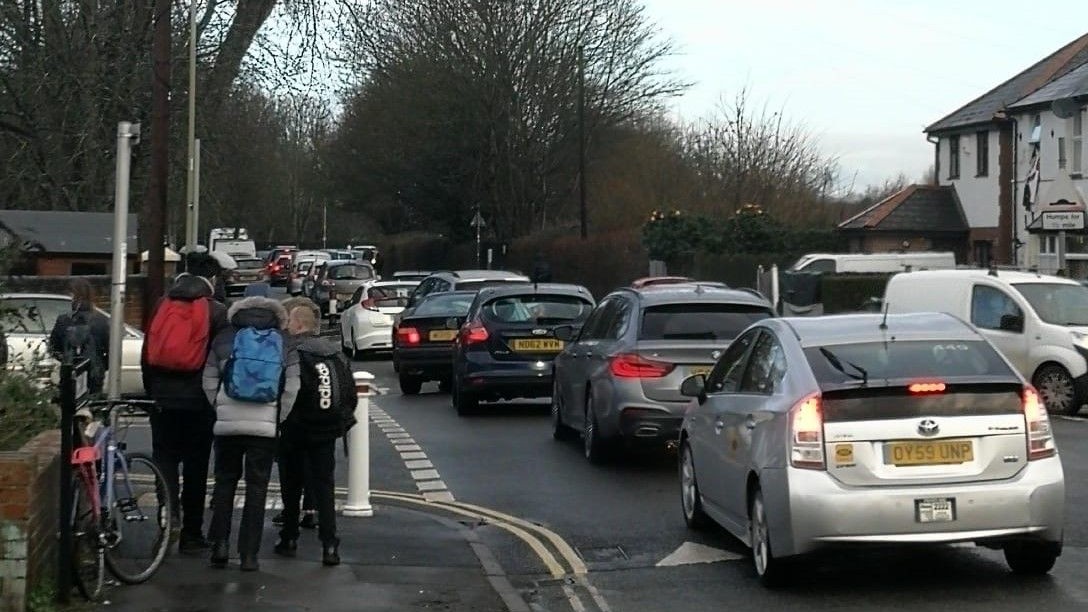
The reality of ‘open roads’: traffic jams on the school run on Rymers Lane, before the Cowley LTN
The historic city of Oxford, hemmed in by rivers and meadows, has had to restrict traffic for decades. The main shopping street, Cornmarket, was pedestrianised in 1973. In every decade since then, bollards and gates have been installed to protect individual streets. There is nothing new about limiting where you can drive in Oxford.
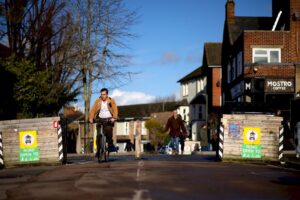
Even the Low Traffic Neighbourhoods introduced in Cowley in 2021 are now well established. Over five years, road injuries have decreased on boundary roads as well as inside the LTNs. It would be irresponsible to propose permanently removing these vital road safety measures.
But we still sometimes hear suggestions that side streets could be ‘opened’ temporarily during heavy congestion. Here’s why that would be counterproductive.
It’s dangerous
Main roads are typically straighter and wider, with safety features such as pedestrian crossings, cycle lanes, and speed cameras. Pushing traffic into minor roads – which are narrower, don’t have marked crossings, and where parked cars reduce visibility – would be dangerous in itself.
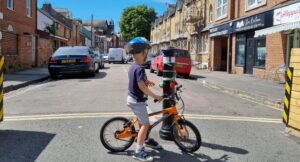
But another problem is that road users who have rightly come to expect low traffic would suddenly face a large number of drivers being diverted through unfamiliar streets. Children cycling to school would have to share their protected space with rush-hour traffic – or, more likely, they’d be pushed off the streets.
It sends the wrong message
You can drive to every address in Oxford, but streets are places to live, not to pass through. Cars are guests, especially in low traffic neighbourhoods. Drivers should respect the residents whose streets they are using.
The Highway Code is clear about priority: it’s drivers who have the greatest responsibility for keeping other road users safe. And Oxfordshire County Council’s transport plan explicitly places walking, wheeling, and cycling above driving.
But opening side streets to traffic would send the message that driving takes priority over living. It would imply that safety is only temporary and can be suspended for the convenience of drivers.
In the rare event that there is genuinely no alternative to rerouting traffic along a side street, all on-street parking needs to be suspended, and safe routes need to be protected with temporary traffic lights and marshals, the same as any high-risk environment.
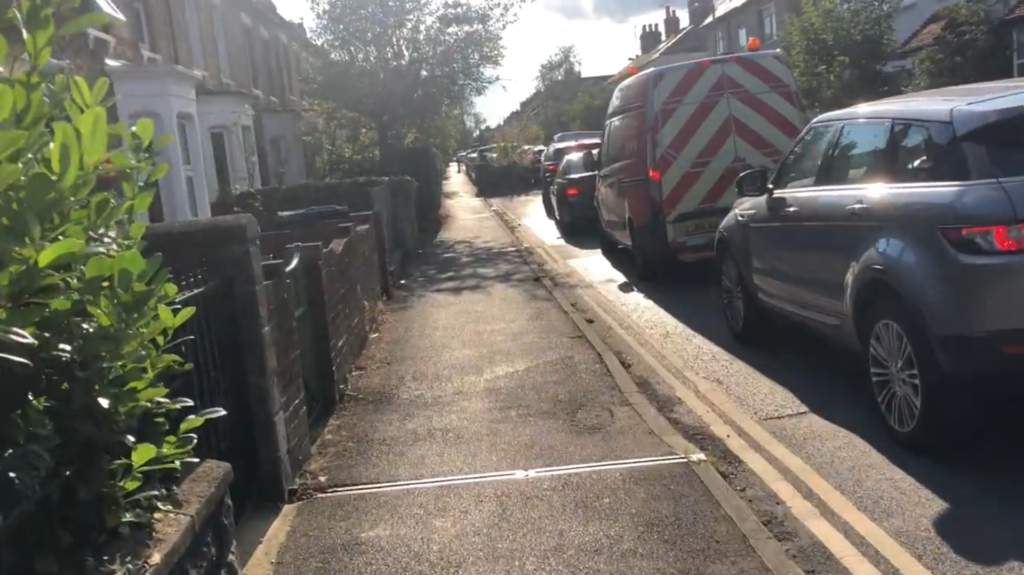
The reality of ‘open roads’: early evening traffic in Howard Street, before the East Oxford LTN (from: This traffic shouldn’t be here – Howard Street, Oxford, YouTube)
And it just won’t work
Before the East Oxford LTNs were introduced, the nose-to-tail traffic seen here would occupy the whole length of Howard Street. On the map, Howard Street might look like a shortcut – but not all roads are the same. As a narrow one-way street with traffic calming, it simply doesn’t have the capacity of A and B roads like Iffley Road and Cowley Road.
It’s common sense that pushing main-road traffic into smaller roads can never relieve congestion. It can only create additional traffic jams. And from experience, we know that when drivers are trying to manoeuvre in and out of side streets instead of staying on the main road, they are more likely to crash, and they slow everyone down.
‘Opening the roads’, whether temporarily or long-term, is a superficial solution to a difficult problem. But it doesn’t survive contact with the real world.
Header photo from: Oxford Clarion, The politics of Low Traffic Neighbourhoods (spring 2024 edition))
Owen Massey has volunteered with Oxford Pedestrians Association and children’s bike ride Kidical Mass.