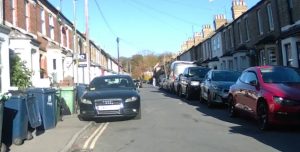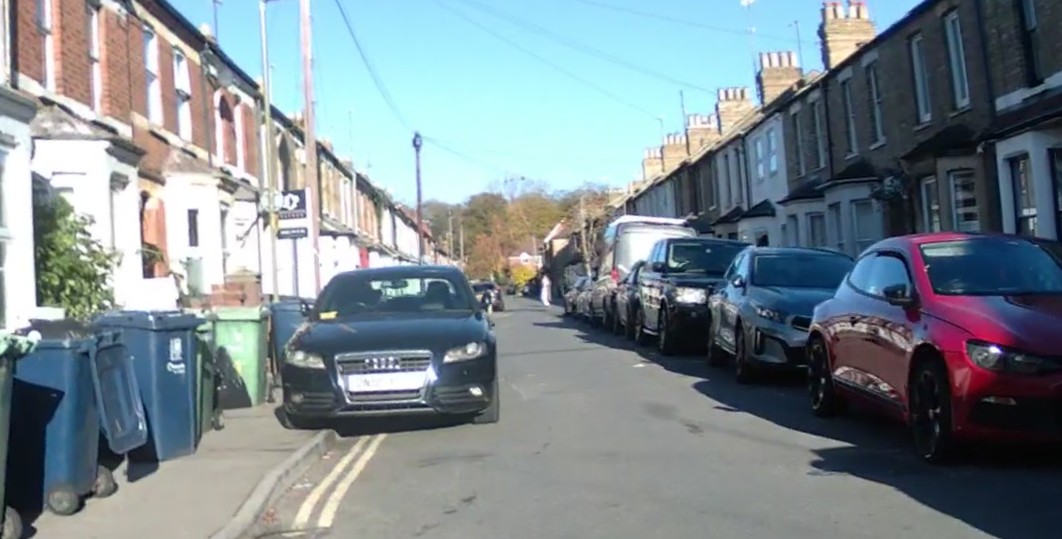
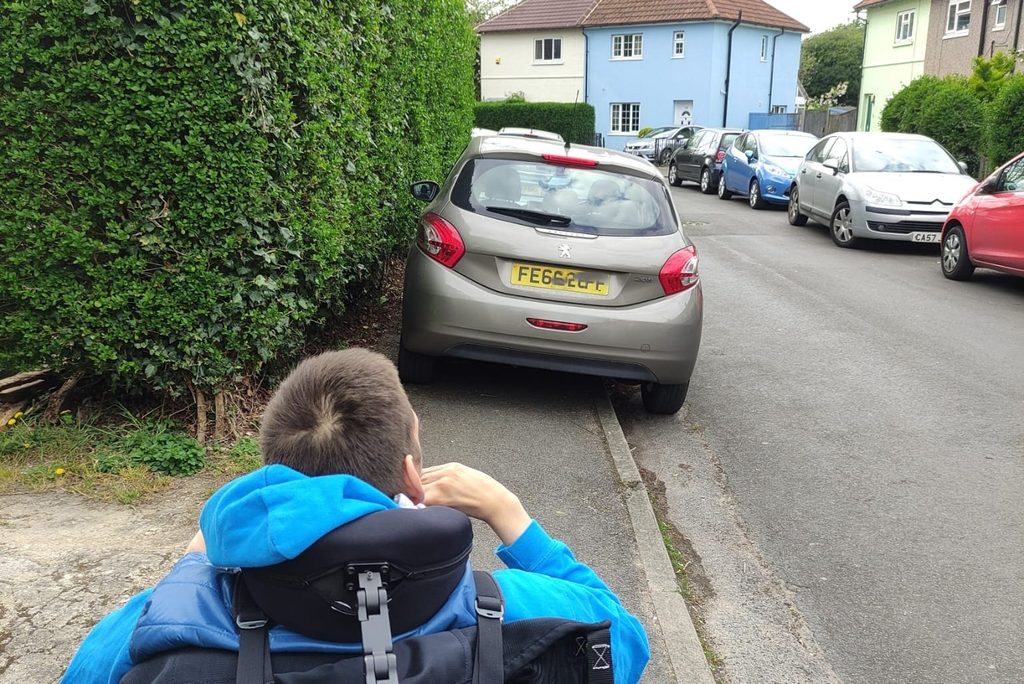
Gradually they are creeping on to our pavements, the last safe place for people. Cars, vans and even American-style pick-up trucks – growing bigger and more numerous in the streets where we live.
This causes a lot of problems – it’s worst for people who are disabled, for children, and for parents or carers. This video from Living Streets points out the problems. We’ll explore below what our Council is preparing to do about it.
Symptom of a bigger problem
But pavement parking is a symptom of a bigger problem. Cars and vans dominating our roads and streets. They kill more than a thousand people through crashes every year in Britain. Thousands more from pollution. Thousands more from induced inactivity.
Car manufacturers don’t care. Far from it. Having reached a limit in car sales, they aim to increase the vehicle prices and replacement frequency to prop up their profits[1]. So, they focus advertising on so-called sport utility vehicles, with unrealistic images of them swooping round country tracks or city streets at speed. The reality is that these cars are often 20 centimetres wider than their predecessors, but no bigger inside, consuming more road or pavement space, and twice as likely to kill a child on impact.
The industry and its friends use every weapon to protect their profits. The recent webinar from the Faculty of Public Health on Cars as a Commercial Determinant of Public Health[2] is an eye opener, and recommended viewing.
Bigger cars emit more pollution? Then reprogram them to defraud emission tests – until you get caught in Dieselgate[3]. People can’t afford bigger cars? Create Personal Contract Plans, designed so people pay less, but never own the car, so when they have to recontract,… pitch them a slightly bigger SUV[4]. PCPs led to a £9 billion mis-selling scandal the industry is still wriggling to minimise[5].
Decades of car and road building have led to a car-dominated society. It’s come at the price of thousands casualty and pollution deaths, the destruction of local shops, services and public transport. It’s also massively unequal. If you are one of the 25% who can’t drive – for disability, financial, age, or whatever reasons – you’re basically stuffed.
Saving the pavement
Our pavements, paths and verges are the most basic mobility facility remaining. And yet, attempts to defend even these from encroachment are attacked as ‘anti-motorist’ or a ‘war on cars’. Bully-boy tactics straight from the playbook of the tobacco sector – attack any resistance as some form of assault, and attempt to deny, distract from, or normalise the harm done by cars. ‘It’s not really a problem’, ‘What about e-bikes?’, ‘Everyone does it’ – all standard tactics.
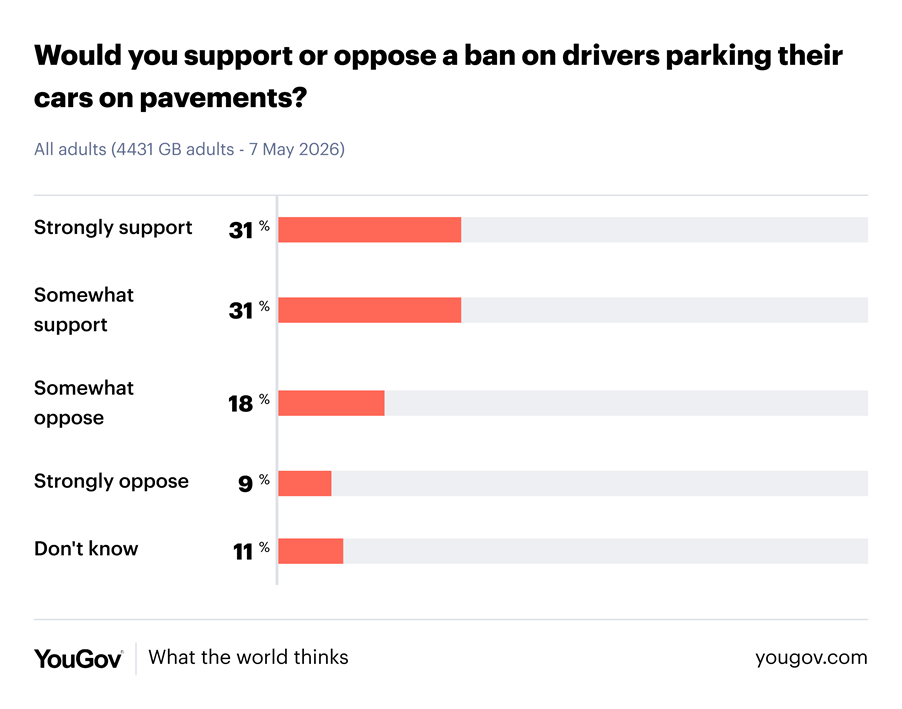
But most of the public wants this to change. A YouGov poll in May 2026 should more than twice as many people support a ban on pavement parking as oppose one, and the clear majority stands regardless of gender, age or politics.
Despite this, it took five years from a consultation 2020 until the Government set out its response in 2026 and approved primary legislation in 2026. However, the secondary legislation is still required to enable Councils to act. The Government promised this before the end of 2026, although it’s not arrived by mid-November.
In Oxfordshire, a Motion approved unanimously (apart from one abstention by the sole Reform member) by Full Council on 30 June 2026[6], agreed to tackle the issue. In November[7], OCC’s Cabinet responded to this Motion by approving preparatory work, ahead of requesting enforcement powers once the legislation is in place.
There was discussion about differences between Oxford (where bad parking is the second most identified form of antisocial behaviour), market towns and rural areas (which may not have ‘pavements’). But each need their own form of solution allowing for people to walk, wheel and cycle safely, prioritised above convenient storage of personal vehicles.
This proposal to protect our pavements paths and verges, is a small and necessary step to protect some space for people, enabling safe, active and healthy movement, for the benefit of everyone.
This blog was adapted from our Co-Chair Robin Tucker’s address to the Cabinet – you can see that, addresses from Cyclox and Oxfordshire Liveable Streets, and the Cabinet discussion on OCC’s YouTube at 51m15s
[1] Article: The financialisation of car consumption
[2] Webinar: https://youtu.be/HMumsMnc6oY
Presentations: https://www.fph.org.uk/media/5mifu4hg/healthy-transport-cars-as-commercial-determinants-slides.pdf
[3] Volkswagen emissions scandal – Wikipedia
[4] Article: The financialisation of car consumption
[5] UK regulator warns car finance firms against low-ball redress offers | Reuters
[6] Oxfordshire County Council 30 June 2026
[7] Cabinet Response to Council Motion on Pavement, Path and Verge Parking (17 November 2026)